Investment Chart Kondratiev Wave

Investment Chart Kondratiev Wave

Monday, 30 April 2012

Niall Ferguson in Barron’s: is the US becoming an anti risk welfare state, going down like Brittan in the 20st century?


Niall Ferguson, the husband of Ajaan Hirsi Ali, the Dutch fighter against islam from Somalia, had this week an interview in Barron’s (Is America Becoming an Anti-Risk Welfare State?). This excellent right wing economic historian was interviewed because of his book Civilization, The West and the Rest.

He is afraid that the US will go down like the Netherlands in the 18th century (the spirit of Jan Salie, who didn’t take any risk after the 17st century in which the Netherlands became the richest nation in the world) or like Brittan after 1913.

He sees two reasons for the coming decay of the US:

1.  1. The institutions no longer work as efficient as in the past. The judicial system is a buren. Litigation is everywhere at a high cost for companies. It has become too complicated (Dodd Frank legislation of 2000 pages etc.) . You create an army of lawyers.

2.2.  The culture in the US is shifting in the direction of no more risk taking. In the past risk taking was in high respect, nowadays it is moral hazard and welfare state thinking is winning. Entrepreneurial spirits are now higher in Hong Kong and Germany than in the US.  

The old powers will be replaced by the new. That is what happened with the UK in the 20st centrury. It became less flexible and the vested interests became a burden (labour unions asking too much, inflexible etc.).

The tremendous growth in the West of the past two centuries was caused by six killer applications according to Ferguson. The rest of the world could not follow. These six are: competition, science, judicial system, modern medicine, consumerism [ thanks to the unions that Ferguson so despises!] and  work ethics.

This is reasonably in line how Ter Veer and I explain in our book why the Industrial Revolution started in Brittan: because of the big flexibility, the powers in the society could shift (becoming stronger and weaker according to the spirit of the age). That compares with competition and the success of consumerism. This works when the domains of the spirit of the age (freedom, justice, care) are well managed.  You must have up to date institutions, a good judicial system, a social welfare system. Then freedom is possible and will work with bigger innovative powers (science of Ferguson) and profits of the invisible hand.

Now sees Ferguson a power shift to China at the cost of the West. The trends of the end of the 20st/ start 21st century will continue, that more and more countries will get richer and close in on the West for income.


Latin America remains on the right path under the lead of Brazil. Institutions will improve further.

Europe will remain a disaster zone. They will keep the euro at a GDP cost of 5-8% per annum.

China is comparable with South Corea in the 70s. Like Korea it will get much richer and not collapse. They will keep a form of state capitalism. It is too dangerous for China to allow a powerful opposition in the coming decades. This system can and will work.

Sunday, 29 April 2012

The Dutch collapse repaired by the Kunduz Coalition


After seven weeks of talking about more fiscal austerity in the Netherlands the right extreme Freedom party PVV couldn’t stand it any more. All those cuttings on care, higher (VAT) taxes made life too difficult for Henk senior, so told Geert wilders, the leader of the PVV, all the crying of his main assistant Fleur Agema had not made the other parties weak. They still listened to the dictates of Brussels, made under pressure of the Dutch, to lower the government deficit below 3% in 2013. So the government fell and it looked like the Dutch were undisciplined non core members of the euro zone.

But surprise, surprise in two days  the three small opposition parties that supported government when they lacked the support of Wilders came with a package that seems to fulfil the wishes of Brussels. The new coalition until the election is called the Kunduz coalition. Kunduz is where the Dutch in Afghanistan try to make good cops of non soldiers. To get that agreed the same three small parties that came with the new package voted for the Kunduz mission (in the eyes of the US this was still  not good enough as effort to keep the Netherlands as the 20th member of the G20) .

 Labour (PvdA) was not involved in the creation of the compromise package. So there was a lot to blame about their new leader Samson, he had missed a big opportunity to show that labour works. All parties involved told literally many times that it was important to jump over their shadows. Samson didn’t manage it as the cartoon shows (Ruben, from NRC).

The spirit of the age has changed. Now labour obstructs all efforts to reform the economy, they are the conservatives now. In the past it was labour that wanted to reform, to profit from the better times that are ahead and the right parties wanted to protect their good fortune. Now it is labour that no longer sees good times ahead, while individuals still see good times ahead.

At the moment the pessimists have the majority, so for electoral profit is it clever to be against reforms, against Europe and to blame the banks.

While in the US the election is between fairness (and care) of Obama or more freedom/ American dream of Romney in the Netherlands it is between anti Europe/ anti immigration conservatism and individual freedom, environment, reforms on the labour market, mortgages and higher retirement ages to make the system sustainable.

Friday, 27 April 2012

Initial claims point to lower growth in the US

The initial claims for unemployment in the US are rising. The beautiful decline is over that pointed to more employment growth and better income growth. After the sudden deterioration a further rise is not that likely. The current rise probably is mainly caused by a payback of the very warm winter weather and this should stop in May.

There are almost no indicators and especially not weekly indicators that move so well up and down with the US economic growth in a quarter (see chart of the comparison).

This rise of the initial claims is a favourite argument for the people who see the US economy sliding to very weak, QE3 prone, growth. They see it as an important clue for a further decline of the Citigroup Economic Surprise Index. However when the rise of initial claims in mainly caused by the weather one should not stay awake because of that.


Thursday, 26 April 2012

Government policy: first big austerity then less: why are most countries doing the opposite and lose?

The change in austerity determines how big the influence of lower government spending/ higher taxes is on growth. So it is a well accepted theory that you have to take as soon as possible the maximum pain that is necessary. In the years after that you can increase austerity further but less fast. Then you get more economic growth. First the acid then the sweet was the victim of wise politicians.

That is how you win elections, see Nixon who was a master how to play the election cycle.

Still most countries in Europe are increasing the austerity every year more. That is a depressing strategy. In 2013 austerity goes up in several countries like the Netherlands, so the Netherlands will lag European growth even more than they do already. Confidence cannot recover with this kind of policy. Some countries have done better like Ireland (applause) and Germany (but Germany didn’t need to do much, so that was easy). There is hope the pace of austerity next year can diminish in Spain, Italy, Ireland. Hollande will maybe prevent the necessary big austerity step for France, that could create all kind of problems.

In the US you will get the fiscal cliff of 2013. The next president should be wise (like Nixon c.s.) and repair no more than half of this cliff, otherwise economic growth will remain low in the US for a long time. He also should continue infrastructure investing and do the austerity elsewhere (necessary but difficult). Still the consensus says: this time is different, in the year after the election we will not do too much fiscal austerity. Would they be as stupid in the US as in Europe?


Tuesday, 24 April 2012

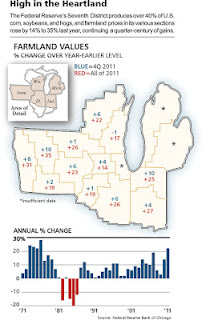
US farmland was one of the best investments, but probably not this year (Barron’s)


One of the best investments you could have made in the last decade was the buying of farmland in the corn belt states of America.


In 2002 farmland in Iowa was sold for a paltry $2,083 per acre; in 2011 that could fetch $6,708.

The article of Barron's: "Down -- but Far From Out -- on the Farm" this week reminds to these wonderful times and they think the golden period is over for a not too long time. The subsidies for ethanol from corn will be diminished, they will add less ethanol to gas than what was promised to the farmers. Everybody is now planting like mad men (record selling of seed by Monsanto reason for upward profit warning) to produce corn for China. 1/3 is export and the export is growing, but maybe not this year because the groth in China this year will be very low (only 8%, but I should think that will not be a reason toe at less food). Some people even think that the corn prices can go down (not a certainty, the Chinese want tof eed their pigs and who knows el niƱo becomes worse than thought). The income of farmers could go down and then there will be less Money left for buying land. The last ten years farm income has exploded and that is why the prices from farm land could explode even more, but with fiscal austerity arriving and some belief in reducing obesitas people think commodity prices will go down.

Another important reason is that the farmers in the corn belt states are now old chaps now (55% is 65+) and they want to sell their land instead of keeping it in the family.

Source charts : Barron’s (Down- but far from out on the farm) and data stream


American dream in danger: young people no longer enthusiastic about driving a car

We live in strange times. I blogged already about Japanese youngsters no longer interested in sex, in credit worthy developing countries that have to subsidise not credit worthy developed countries and now we are shocked by American youth no longer wanting to drive a car (in Japan that is even more extreme).


Per capita peolpe drive now in the US as much as in 1995. The US is no longer itself since the credit crisis. The main culprit are the people below 35 that drive much less.

The car, the symbol of independency, is no longer a must for a bigger and bigger part of the US youth. They prefer to sit behind a computer, chatting on Facebook etc, they borrow the car of daddy sometimes and say they want to protect the environment. Gas gurglers are out, less gas consuming cars are in.

A growing part of the youth is too lazy to get a drivers licence, they are scared by lower subsidies/ less possibilities to learn driving at schools. In ten year time the number people below 30 (and above 15) without a drivers licence from 21% to 26%. This is not only because of the high unemployment of the below 30’s. Even bonus getting too much earning youth loathes cars nowadays. Partly that is because of the high gas prices.

The car manufacturers try to get those environment in love again with cars by offering electrical cars with spottify and social media installed.

Sources: FT Young Americans turn away from driving: http://www.ft.com/cms/s/0/78420798-895c-11e1-bed0-00144feab49a.html#ixzz1sZ0s92qB

chart:

http://www.businessinsider.com/vehicle-miles-driven-february-2012-4#ixzz1ssG9QngW

Friday, 20 April 2012

Coming nationalisation of YPF shows risks of Emerging Markets again: list of 10 biggest nationalisations of commodity producers after 1950

In Argentina Kirchner thought it could come in handy to nationalise YPF (what is in the name; it means Oil Fields of the State) before entering oil fields before the coast, to take it from Repsol, a not outperforming energy producer this year. Cartoonist saw a chance with their picture where Rajoy takes Messi in return for YPF.


The FT had a few days ago a list of big nationalisations of oil companies/ commodity producers after WWII:

1. Mexico nationalised all oil companies. Salinas feared that the CIA wanted a coupe against him and his party. Pemex was created and the second rate technology since then is one of the reasons that the Mexican oil production is falling so much and so litlle new fields are developed.

2. Iran that under Mossadeq in 1951 took Anglo Iranian (now BP)

3. Codelco, the biggest copper mine in the world, nationalised by Allende in 1973. As favour in return the CIA abdicated him and mad Pinochet president of Chili, by the way he did not give back Codelco.

4. Libiƫ thought in 1971 that BP must get rid of the Sarir field. Several other countries in the region thought that a splendid idea, especially in 1972 Saddam Hoessein and also Aramco had the same idea but nationalised a bit more pretty.

5. Fidel Castro took all American sugar plantations/ refineries etc. in 1959. Until now the CIA did not manage to kill Fidel as return favour.

6. In 2007 Chavez wanted the Orinoco fields of Exxon Moblie and Conoco Philips

7. Yukos was given by Putin to Rosneft because of unfavourable political. Yukos claimed $100B damage.[ not mentioned: Royal Dutch Shell that had to give its share in the Sachalin fields to Russia]

8. Evo Morales was a man of his word and nationalised the oil and gas inteersts when he rose to power after 2006.

9. Ecuador took the possessions of Occidental, with a value of only ca $ 1B

10. In 1956 Nasser took the Suez canal in ‘Operation Dignity and Glory’

Well that are enough examples that investing in Emerging Markets is not without risk.

Thursday, 19 April 2012

Tupac hologram on tour

Technological developments are clearly accelerating in the last year(s). Apple invents one after other success gagdet. Laptops should not be bought until the end of 2012 because of tremendous changes, progress with special Intel chips and Windows 8. Touch screen will then be perfectly normal.

I blogged already about 3D printing and that makes astonishing progress (this week you saw articles about printing of medical drugs and prosthesis) . We are at the start of a medical revolution, with emphasis on personal drugs and prevention of all kind of diseases (according to Kaku in his book: physics of the future).

Also the Google glasses will change life and when law of Moore will continue long enough it will become contact lenses.

But the life presentation of Tupac, diseased in 1996, now as hologram this week for a mass pop audience, that really did steal the show. Tupac (and others) will go on a virtual tour. Physicists explained patiently how you can create these 2D holograms. Fake mediums can make now spectacular ghost appearances. Also the Wall Street Journal discussed the life performance of the rapper Tupac. Even only 2D, it is very spectacular. 3D will not be far off. When the price comes down you can put movie stars as hologram on your bank at home saying nice things. It will not be long before you will be as hologram on business conferences instead of video conferences.

Tuesday, 17 April 2012

SP500 versus commodities since 1870


The chart above is from Barry Bannister/Stifel Nicolaus (via Business Insider).
The message is that equities could do well in the future (the chart is from half 2011) especially compared to commodities.
Of course that is very unvertain because the demand from emerging markets for commodities is very strong. But it is very well possible because equities are way too cheap and don't discount the high profit growth you get when there are many innovations and a big output gap that slowly is closing.
Compared to our chart of the Kondratiev wave you don't have the same turning points, but often they are the same.

Recovery US since 2009 this time different


The two charts of benderly (Applied Global Macro Research nowadays) show that goods have recovered as should have happened after a deep recession (manufacturing base in the US is coming back), while the service sector is doing way worse than ever after a recovery. Normally services are growing fast and take an ever bigger part of GDP.
This time was different. Productivity growth is hurting civil servants and maybe some other jobs in the service sector. That is quite unusual (productivity growth is only measured for the private sector, the productivity growth of the government is by definition 0; this definition should be changed).

Employment growth by sector before and from 2009 in the US


The chart shows employment growth before and from 2009 and how big the sector is. Construction and somewhat surprising civil servants are the big losers since 2009. Also the financial sector (all those mortgage sellers to muppets etc.) did do badly.

Cars, professionals and temps did very well since 2009. The rebirth of US manufacturing seems to have started.
Healthcare was and is the big engine for employment growth (a touch less since 2009)

source: Atlanta FED
http://macroblog.typepad.com/.a/6a00d8341c834f53ef016764261d7e970b-800wi

Biggest food consumers: per country and expressed in Big Macs


In the article Grocers' green signalled The Economist that China has become the biggest player again in a new market: the grocery market (China overtakes America to become the world's largest grocery market)
That China has become the biggest market is only caused by its huge number of people, not because of their high consumption per capita (at the right side in the table of The Economist). That is why India is also high on the list, even with its very low spending for food per head.


I added a table what the list would be per big country the list when they had spent all their Money at Big Macs. Then you get a bit the food consumption according to purchasing power parity.
Then you see per head France is still at the top of the list with a hypothetical consumption of 1070 big macs, followed by England with 958 and Australia with 909. Russia is on a suprisingly high place four with 874, even before the US (698) and Japan (745).
In Germany they obviously don’t spend much money on food (it is living like Gof in France, not in Germany)..
The other BRIC’s are together with Indonesia at the lowest places. Because big macs in Brazil are extremely expensive and cheap in Mexico, is Mexico still above Brazil, even while they spend less money at food in Mexico than in Brazil (in dollars).

Why are gold mines so cheap?


In the Barrons' Abelson thinks gold mines will do what their name suggest (Up and Down Wall Street Saturday, April, 2012 A Golden Opportunity). He not the only one. A lot of well known investors/ hedge funds think gold mines are cheap. They have burned severely their fingers in the last months. Gold mines are already for quite some time ridiculously cheap and they are not following the gold prices up very well. The market prefers the real thing: gold in their hands, even the gold ETF’s are mistrusted because maybe they cannot deliver the physical thing and maybe some other things could go wrong. And that is what you don’t want when you buy gold, all those fears.

For commodity prices it has been quite normal that the commodity producers couldn’t follow the commodity prices. But for gold mines te difference starts to become too big and it seems to get only worse. Many gold bulls are now so disappointed that they to their horror are selling. The sentiment is for the fourth time in a year bearish and so the bulls hope on a contrary movement. Gold mines have too much cash and they are slowly buying each other. Even that has not helped te prices.
The reasons for the bad performance are the preference for physical gold and the higher volatility of the prices of gold mines and the unreliable following of the gold prices.
In the articles quoted below these things are discussed well. Especially the argument that the relative volatility is now not a problem could be the right reason to become bullish. After so much underperformance you can argue it has to turn but markets can remain longer cruel than your patience.

source: Where’s the Beef for Gold Equities? By Frank Holmes
http://advisorperspectives.com/commentaries/global_041312.php

Sunday, 15 April 2012

How big are the fixed income/ sovereign markets in the world according to IMF


The IMF had a chapter about safe fixed income markets in the world. A bit prudent they called it potentially safe investments. Somewhat curious they counted gold as a safe fixed income investment.

The numbers are only about quoted bonds, not the loans of the social securities in the US that own big chunks of US non quoted sovereign debt. It is also not about normal bank loans and mortgages.

The table below gives the sovereigns in some important countries/ areas and who owns these return free risks.

Pension funds don’t owe so many as I thought, but together with insurance companies they have plenty of them. The Japanese Postbank is a huge player in Japan and there they keep the investors awake that they don’t buy any Japanese sovereigns.
The central banks of the US, Japan and the UK have lots of sovereigns, the ECB owns almost nothing (so there is room to buy lots more).

source http://www.imf.org/external/pubs/ft/gfsr/2012/01/pdf/c3.pdf